I Spent a Month Buying Only Music Under Five Bucks and It Rewired My Taste
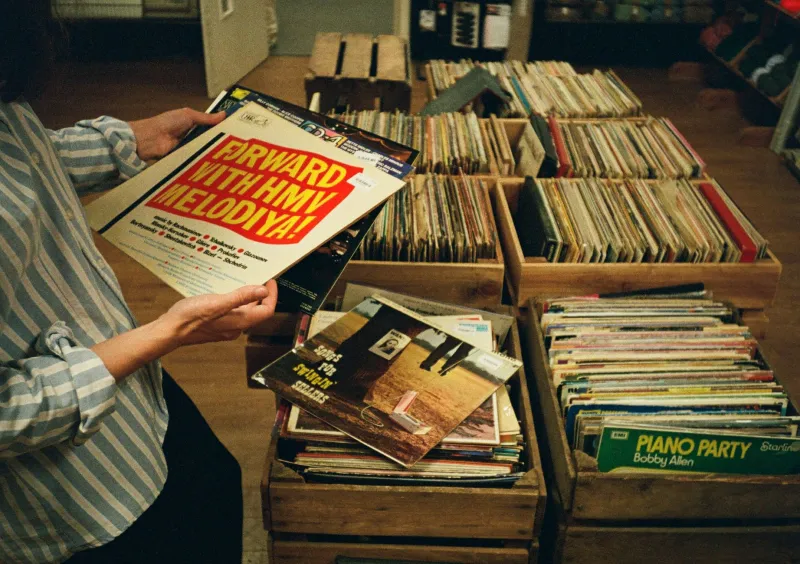
There's a moment that happens in every record store, usually near the back, past the new pressings that all cost more than a decent dinner. You find a cardboard box. Or a milk crate. Or a long, low wooden bin with a hand-written sign that says something like "$1 EACH — AS IS." Inside: hundreds of records with no algorithmic endorsement, no editorial pitch, no friend-of-a-friend recommendation. Just covers. Some beautiful. Some deeply cursed.
For the past month, I only bought music that cost less than five bucks. No streaming adds, no Bandcamp wishlists, no algorithm-assisted "you might also like." If I wanted to hear something new, it had to come out of a cheap crate. Here's what happened.
The Rules of the Game
Simple enough: any music I discovered during February had to physically exist and cost under $5. Thrift stores, estate sales, dollar bins, garage sales, that one flea market outside Columbus where a guy sells unmarked boxes of 45s for a flat ten. I could listen at home on my dusty turntable, but the discovery mechanism had to be analog and cheap.
Week one was humbling. I brought home a lot of stuff I didn't finish. A 1978 easy listening compilation. A live album by a band whose name I genuinely cannot read on the cover. A Christmas record I bought ironically in February, which is its own kind of confession.
But somewhere around week two, something shifted.
Cheap Music Makes You Brave
Here's the psychological trick of the five-dollar rule: when an album costs less than a sandwich, you take risks. I'd never gamble $30 on an unknown jazz record from 1964. But for two bucks? Sure. Why not. Worst case, I'm out the price of a gas station coffee.
That's the thing the algorithm never gives you — permission to be wrong. Streaming discovery is engineered to minimize risk, which means it minimizes surprise too. Every recommended track is a close cousin of something you already saved. The dollar bin has no idea who you are. It hands you a polka greatest hits and a psychedelic folk LP with a peeled-off library sticker and says, figure it out.
Some of my favorite finds: a scratchy Herb Alpert record that turned out to be perfect Sunday-morning material. An unknown singer-songwriter LP from a regional label that folded in 1975 — the kind of artist who played every bar between Tulsa and Amarillo and never got further. A gospel compilation recorded live in a Detroit church that genuinely gave me chills.
None of it would've surfaced in my feed. None of it needed to.
The Thrill Isn't Just the Music
I'll be honest: part of this is about the music, and part of it is about everything else. The hunt. The flip. The little gasp when you spot a cover you recognize from a sample or a movie. Crate digging is one of the last music experiences that requires your whole body — bending, squatting, thumbing through sleeves while a shop dog watches you with suspicion.
And the imperfections are features. The previous owner's name written in pen on the label. A coupon from 1983 tucked inside a Steely Dan record. The occasional mysterious stain that we choose not to investigate. These records have histories. Your algorithmically-served playlist does not.
Where to Dig: A Quick Field Guide
You don't need to live in a mega-city to find good cheap crates. Honestly, mid-sized American towns might be better, because the records stayed local. A few tips from my month out there:
Estate sales beat thrift stores. People who owned record collections for fifty years are, statistically, people whose collections eventually hit the estate sale circuit. Check EstateSales.net for Saturday mornings and go early.
The dollar bin at a real record shop is curated by accident. Shops in places like Asheville, Omaha, Tucson, and Boise tend to have deep, weird bins because their stock comes from local collections, not national distributors.
Church rummage sales are criminally underrated. The classical and jazz sections are often untouched, which means the good stuff is still sitting there at $1 a sleeve.
Check the vinyl, not just the cover. Hold the record up to the light. A little surface noise is character; a visible crack is a coaster.
What a Month of Cheap Records Taught Me
Taste isn't something you have. It's something you build, and you build it by listening to things without a guarantee. The dollar bin forced me to sit with music I'd never chosen — and some of it rewired what I reach for now.
Streaming is incredible. I'm not going to pretend otherwise. But there's a specific kind of love you only develop for an album you found, physically, for the price of a lottery ticket, in a box under a table in a stranger's garage.
The $15 vinyl dead zone is real — the middle ground where reissues cost a fortune and nothing feels affordable. But down at the bottom of the price ladder, discovery is still alive and well. It just smells a little like mildew. Go dig.