Forty True Fans and a Locked Door: Inside Indie's Anti-Breakout Movement
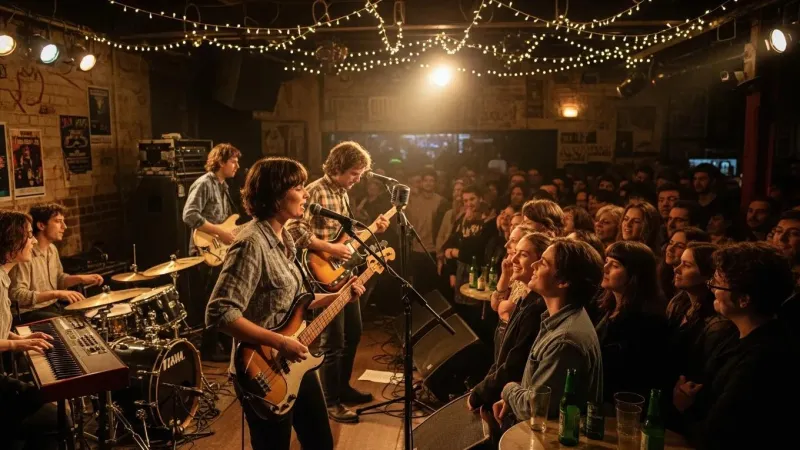
Photo: small intimate indie band performing in tiny basement venue crowd, via www.couchconcert.com
There's a moment in almost every band's life when someone with a spreadsheet asks if you'd like to be bigger. More often than not, the answer is obvious. Yes. Obviously yes. Send the pitch, take the placement, play the showcase.
And then there's the other answer — the one nobody puts in a press release.
The Band That Said No to the Algorithm
Take the Ohio-based four-piece who asked me not to use their name, because the last time a write-up circulated too widely, things got weird. A Spotify editorial playlist added one of their tracks, their monthly listeners jumped by a factor of forty, and within weeks they were fielding calls from a booking agent who wanted them in a 500-cap room in three cities they'd never played.
"We didn't want the song to be a gateway drug to us," the guitarist told me over the phone, only half-joking. "We wanted it to be a really good song. Those are different goals."
They asked the label to pull the track from the playlist. The label thought they'd lost their minds. The band thought they'd found theirs.
This is the part of indie music nobody romanticizes: the deliberate ceiling. Not a band failing to break out — a band refusing to. Capping ticket sales at the venue's actual comfortable capacity. Declining sync licensing because the show "didn't feel right." Answering the dream email from a bigger label with something dangerously close to "thanks, but no thanks."
Making It, Redefined
The hustle narrative is so baked into American music culture that it barely reads as a choice anymore. Grind, post, pitch, repeat — the assumption is that any artist with talent and enough elbow grease should trend upward, forever, until the arena doors open.
But spend enough time around the smaller rooms — the dive in Columbus, the co-op in Olympia, the bookstore basement in Asheville — and you start meeting artists operating on a completely different scoreboard. For them, "making it" looks like a decade of Tuesday night gigs where the same forty people show up, know the words, and stick around to help load the van.
One singer-songwriter in Portland put it to me like this: "I watched friends of mine get a sync in a Netflix show and their whole relationship to music changed overnight. Suddenly every song was a pitch. They stopped writing anything they couldn't explain in a meeting. I make coffee for a living. My band makes rent-adjacent money. And I still get nervous-excited before every show. I don't want to trade that for reach."
It's tempting to read this as sour grapes — artists who couldn't make it big deciding big wasn't worth it. But the math doesn't support the cope. Several of the musicians I spoke with had real offers on the table. Real playlist adds. Real interest. They ran the numbers on what growth would actually cost — the van upgrades, the booking percentages, the pressure to post — and decided the trade wasn't worth their Tuesday nights.
The Economics of Staying Small
Here's the genuinely interesting part: staying small is, in some cases, the more stable business model.
A band with 900 devoted listeners who buy a $25 ticket, a $30 shirt, and the occasional vinyl pressing has a revenue base that doesn't fluctuate with an algorithm's mood. Compare that to a band with 90,000 passive monthly listeners and a royalty statement that reads like a rounding error. The under-1,000 crowd isn't a failure state. It's a patronage system with better merch tables.
Some of these acts have gotten intentional about it. Hard caps on ticket sales so the room never feels half-empty. Email lists instead of social strategies. Merch priced to be bought, not admired. One bassist described their approach as "running a very small restaurant that's always full" — no expansion, no second location, just a room that knows your name.
There's even a quiet pride in the gatekeeping. "People discover us the way I discovered my favorite bands," the Ohio guitarist said. "A friend plays them a song in a car. They come to a show. They tell another friend. It's slow. It's supposed to be slow."
Is This Romantic Nonsense? Maybe a Little
Let's not fully mythologize this. Staying small is easier to choose with a day job, a partner with insurance, or a trust fund nobody mentions in interviews. Some of the anti-breakout crowd is making a virtue of a comfortable situation. And there are artists grinding through 100-cap rooms who would take the playlist add in a heartbeat and be right to do it.
But the movement — and it does feel like a movement, however small and self-selecting — is asking a question worth sitting with: what is all this growth for? If the answer is "so more people can hear the songs," the under-1,000 club would gently point out that more people hearing your song isn't the same as more people hearing your song. Attention isn't absorption. A million passive streams can vanish without a trace. Forty people in a basement singing your bridge back to you does not.
The Long Game Sounds Like This
The bands in this piece will probably never headline your festival. That's the point. Their careers are measured in years of Tuesday nights, not chart positions, and their definition of success fits in a room you could stand in and count everyone.
If that sounds like a smaller life, spend one evening at one of their shows first. Watch a songwriter look out at a crowd where every face is familiar, play a new song nobody's heard, and have forty people absolutely locked in by the second chorus.
That's not a stepping stone to making it.
For some bands, that is making it. They just had the nerve to notice.